Hinges, locks, feet – how to choose the right accessories for WC cabins
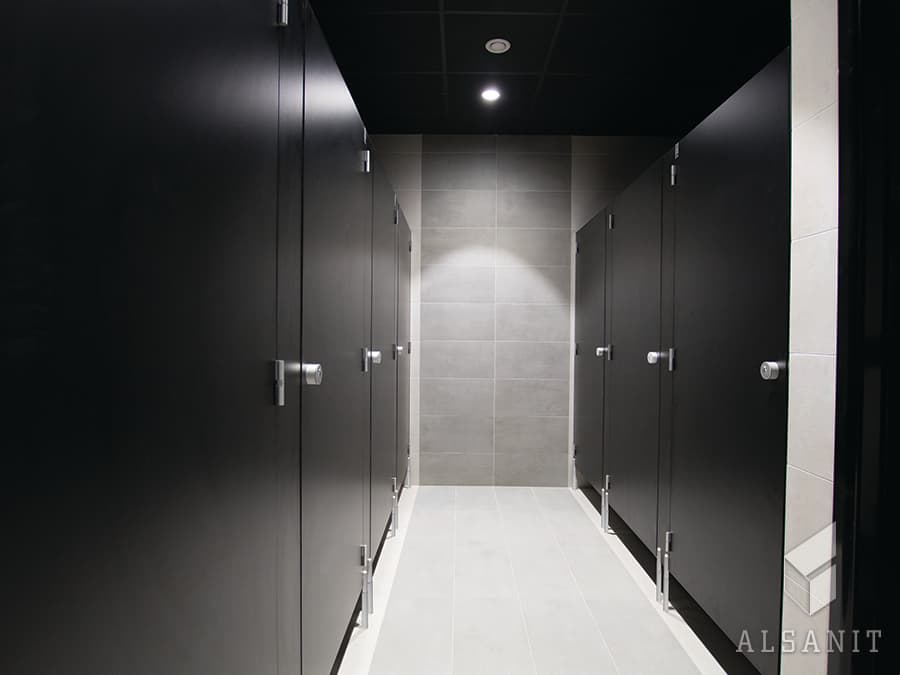
Sometimes it’s the details that determine the comfort and durability of toilet cubicles. Hinges, locks, and legs work every day, and you expect them to simply “do the job.” Choosing accessories doesn’t have to be difficult if you know what to look for. I’ll show you simple criteria, examples, and ready-made decision sets. Stay with me until the end and choose solutions that will work in your facility.
In this article you will learn…
- how to distinguish accessories for a low- and high-traffic facility;
- what materials are hinges, locks and legs made of and when to use them;
- how to choose hinges according to the door weight and required self-closing function;
- how to plan locks, occupancy indicators and emergency opening systems;
- how to adjust the height of the legs and reinforcements to make the cabins stable;
- what accessibility standards and service practices to consider in the design.
What are the differences between hinges, locks and legs in toilet cabins?
These three groups of accessories perform different roles and wear out at different rates. Hinges are responsible for smooth movement and proper door return. Locks ensure privacy and easy opening in an emergency. Legs support loads and stabilize the entire structure.
To choose the right one, first define your usage conditions. Consider traffic intensity and user types. Establish clear evaluation criteria and proceed to compare solutions:
- in schools and sports facilities, choose reinforced hinges and massive metal legs;
- in offices and hotels, accessories with an elegant finish, e.g. brushed steel, will work well;
- in swimming pools and wet areas, choose stainless steel elements with increased corrosion resistance (e.g. AISI 316) or durable technical nylon;
- in restaurants and open-space offices, pay attention to quiet operation – bumpers and plastic elements that dampen vibrations help with this;
- in accessible spaces, remember to use locks with a large handle and a clear occupancy indicator.
Finally, match the accessories to the partition thickness and door leaf material. Compact HPL boards are typically 10–12 mm thick, while laminated particleboard (MFC) is approximately 18 mm thick. Select accessories for the specific thickness and manufacturer’s recommended mounting spacing. Ensure compatible screw diameters and types – this will shorten installation and reduce the risk of looseness.
How to choose the accessory material according to the facility conditions?
The most versatile is stainless steel, which tolerates moisture well and has high impact resistance. Technical nylon (often reinforced) is quiet, non-corrosive, and performs well in contact with moisture and pool chemicals. Aluminum is primarily used for profiles, beams, and slats – the anodized version provides aesthetics and corrosion resistance, but has lower mechanical resistance than steel. For premium facilities and areas constantly exposed to chlorine or salt, consider acid-resistant steel with increased corrosion resistance, such as AISI 316.
How to choose the right hinges for toilet cabins?
Start with the door’s weight and dimensions. Heavier doors require a higher load-bearing capacity and two, or sometimes three, hinges. Check whether the door requires a return to the closed position (self-closing hinges) or a neutral rest position. Pay attention to the adjustments and the possibility of micro-adjustments after installation.
In high-traffic cubicles, choose hinges with a robust construction and durable bearings or sliding bushings. In areas where acoustic comfort is important, use bumpers and plastic spacers that reduce noise when closing. In family and school facilities, ensure the door can be opened from the outside in an emergency – a lock with an emergency opening function is the solution.
Before purchasing, check compatibility with door thickness and board type (HPL/MFC). The opening angle and mounting method (e.g., through-the-wall or edge-mounted) are important factors. Pay attention to corrosion resistance and access to service screws if you plan on regular maintenance.
How to plan locks and bolts for privacy and security?
Choose a lock with a clear occupancy indicator visible from a distance. In public restrooms, opt for emergency opening from the outside (e.g., with a coin or service key) without damaging the door leaf. In areas with a high risk of vandalism, avoid protruding elements and choose bolts with concealed mounting. In disabled-accessible restrooms, use large, ergonomic handles and elements that are clearly visible against the background.
How to choose legs and reinforcements to make the cabins stable?
Determine the required floor clearance and check for slopes. The adjustable feet should compensate for any unevenness and allow for easy cleaning. For long runs of cubicles, use connectors and upper beams (transoms) to stiffen the front lines and ensure stability.
In high-traffic facilities, choose metal legs with a wide base. Plastic and corrosion-resistant stainless steel legs work well in wet areas. For children’s cubicles, consider lower clearances, which facilitate supervision and hygiene. For solid doors, use additional bumpers to absorb impacts and reduce the load on the hinges.
How high should the clearances be set at the floor and ceiling?
A practical standard is approximately 150 mm above the floor, which allows for easy cleaning and air circulation. In very wet areas, the clearance can be increased to 180–200 mm. In children’s cubicles, the clearance can be lower to restrict visibility but still facilitate cleaning. If using a top beam, ensure it does not interfere with air vents and sensors.
How to facilitate the installation and subsequent maintenance of accessories?
Ensure hole spacing and screw selection match the board and subfloor material. Mark mounting points with a template to avoid shifting and looseness. Use spacers to protect the laminate from crushing. After installation, check the tightening torque and adjust the closing torque.
Below you will find simple practices that will speed up your work and reduce the risk of complaints:
- prepare assembly kits sorted into cabins and doors;
- if the manufacturer provides it, use neutral lubricants that are safe for HPL and stainless steel;
- protect edges and fronts with tape when drilling;
- After the first week of operation, inspect and tighten the screws;
- enter the service into the facility maintenance schedule.
Finally, provide the user with brief cleaning and periodic inspection instructions. Create a simple, one-page service protocol. Record inspection dates and notes on accessory operation. This will make it easy to spot wear and tear and replace components before a breakdown occurs.
How to design accessories in accordance with standards and availability?
In accessible cabins, use larger handles and latches that can be operated with a hand or elbow. Ensure that doors can be opened in an emergency while maintaining privacy. Levers and knobs should contrast with the background to be visible to visually impaired people. Ensure smooth door movement and no thresholds that would impede wheelchair access. Select mounting heights that keep components within reach of the seated person. In public spaces, avoid sharp edges and choose smooth profiles.
How to test cabins after installing accessories?
Check the smoothness of the door opening and closing several times in a row. Assess whether the occupancy indicator is working properly and is legible from a distance of several meters. Measure the clearance above the floor and the stability of the door front under lateral pressure. Listen for any unwanted noises and for any interference with the lock. Finally, perform an emergency opening test and record the result in a report.
What should you pay attention to when durability and aesthetics matter?
Choose consistent finishes: brushed steel for modern offices, satin or black for minimalist interiors, and neutral gray nylon for schools. Choose accessories with hidden screws for clean lines. Look for models with proven corrosion resistance and tested durability. Check the availability of replacement parts to maintain a consistent look for years to come.
Frequently asked questions about toilet cabin accessories
Selecting accessories can be complex, but you can summarize the process in a few simple steps. Below, you’ll find answers to questions that arise most frequently during design and installation.